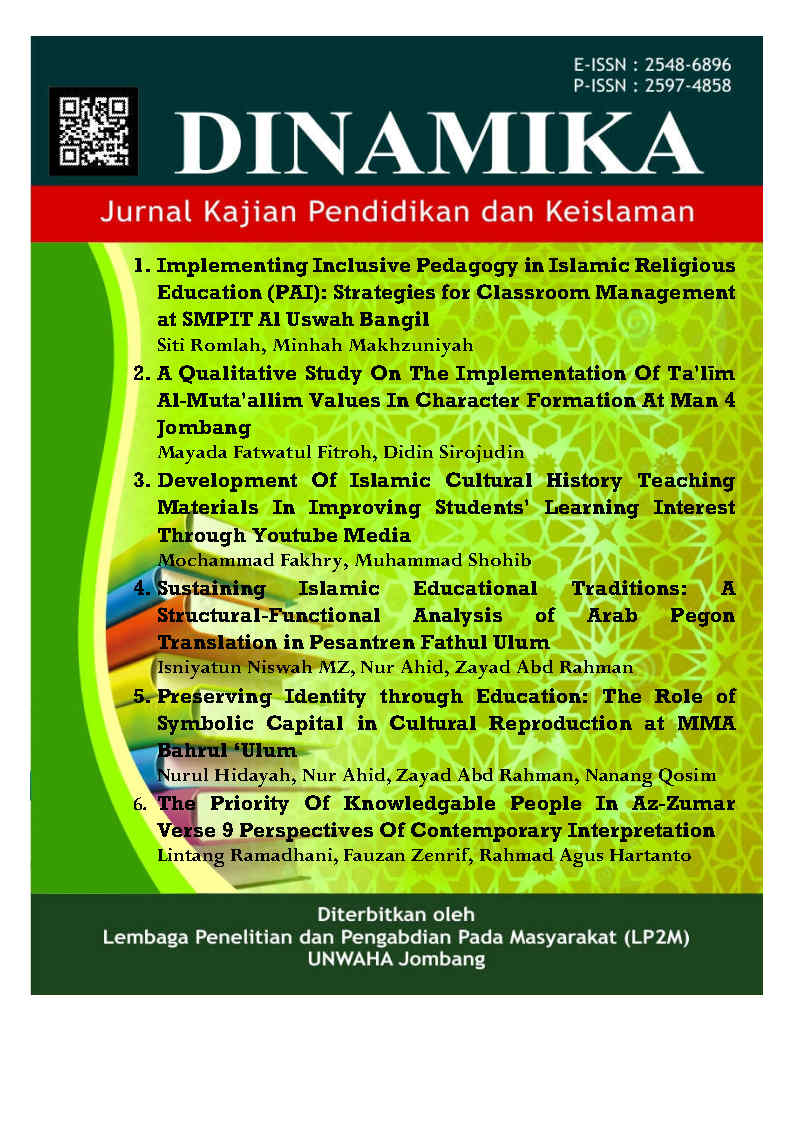
Preserving Identity through Education: The Role of Symbolic Capital in Cultural Reproduction at MMA Bahrul ‘Ulum
DOI:
https://doi.org/10.32764/dinamika.v10i1.5865Abstract
This study examines the process of cultural reproduction at Madrasah Mu’allimin Mu’allimat (MMA) Bahrul ‘Ulum through the sociological lens of Pierre Bourdieu. The research focuses on how this traditional Islamic educational institution sustains religious and cultural values by shaping the habitus of its students. Using a qualitative approach and analyzing daily practices within the pesantren environment, the study finds that MMA Bahrul ‘Ulum reproduces culture through internal mechanisms such as discipline reinforcement, classical Islamic text learning, and symbolic relationships between teachers and students. Symbolic and cultural capital play a crucial role in maintaining the institution’s authority amid social change. The findings reveal that the process of cultural reproduction at MMA Bahrul ‘Ulum is not passive but rather active and dynamic, enabling the institution to preserve tradition while adapting to contemporary challenges. This research highlights the strategic role of pesantren in maintaining cultural identity through the formation of a distinctive habitus.
Downloads
References
Adib, M. (2012). Agen dan Struktur dalam Pandangan Piere Bourdieu. BioKultur, I(2), 91–110.
Azizah, A. N. (2010). Sejarah Perkembangan Madrasah Mu’allimin Mu’allimat Bahrul Ulum Tambakberas, Jombang Jawa Timur Tahun 1956-1980. IAIN Sunan Ampel Surabaya.
Bafodhil, I. (2022). Manajemen Lembaga Pendidikan Islam Di Indonesia. Jurnal Ilmiah Pendidikan Dan Keislaman, 2(1), 35–46. https://doi.org/10.55883/jipkis.v2i1.23
Bourdieu, P. (1985). The social space and the genesis of groups. Social Science Information, 24(2), 195–220.
Bourdieu, P. (2020). Outline of a Theory of Practice. In The new social theory reader (pp. 80–86). Routledge.
Bourdieu, P., & Passeron, J. (1990). Reproduction in education, culture and society. In Trans. Nice, R. London: Sage.
Broek, V. Den, & Elsa, G. S. (2012). Innovative Research-Based Approaches to Learning and Teaching. OECD Education Working Papers, (79), 1–31.
Cooper, V., & Whyte, D. (2022). Grenfell, austerity, and institutional violence. Sociological Research Online, 27(1), 207–216.
Creswell, J. W. (2015). Research Design: Qualitative, Quantitative, and Mixed Methode Approaches. United Kingdom: SAGE Publication.
Dhofier, Z. (1980). The Pesantren Tradition : a Study of the Role of the Kyai in the Maintenance of the Traditional Ideology of Islam in Java. The Autralian National University.
Erickson, P. A., & Murphy, L. D. (2018). Sejarah Teori Antropologi Penjelasan Komprehensif. Prenada Media.
Fatimah, K., Putra, V. G. R., Viono, T., & Busri, H. (2024). Dimensi Reward dan Punishment dalam Pendidikan: Perspesktif Hierarki Kebutuhan Maslow. AS-SABIQUN, 6(4), 682–708.
Grenfell, M. (2014). Pierre Bourdieu: key concepts. Routledge.
Horvath, P. (1991). Ideas on the Subject of Autonomy of Universities. Annales U. Sci. Budapestinensis Rolando Eotvos Nominatae, 32, 187.
Karnanta, K. Y. (2013). PARADIGMA TEORI ARENA PRODUKSI KULTURAL SASTRA: KAJIAN TERHADAP PEMIKIRAN PIERRE BOURDIEU. Jurnal Poetika, 1(1), 3–15.
Lamaison, P., & Bourdieu, P. (1986). From rules to strategies: An interview with Pierre Bourdieu. Cultural Anthropology, 1(1), 110–120.
Lyons, A. P. (1980). Pierre Bourdieu. Outline of a Theory of Practice. Trans. by Richard Nice. Cambridge, London, New York, Melbourne: Cambridge University Press, 1977. viii+ 248 pp. Figures, notes, index. $18.95. ASA Review of Books, 6, 232–235.
Munafi, L. O. A. (2024). Teori Habitus dan Ranah Pierre Bourdieu (Teori Sosiologi). In CV Eureka Media Aksara.
Nahdi, K. (2013). Dinamika Pesantren Nahdlatul Wathan dalam Perspektif Pendidikan, Sosial, dan Modal. Islamica: Jurnal Studi Keislaman, 7(2), 381–405.
Papoulia‐Tzelepi, P. (1993). Teaching practice curriculum in teacher education: A proposed outline. European Journal of Teacher Education, 16(2), 147–162.
Rahman, K. (2018). Perkembangan Pendidikan Islam di Indonesia. 3(2), 91–102.
Recke, R. (2011). Converging principles of norm, rule, and practice: Tracing normativity beyond semantics in Bourdieu’s Outline of a Theory of Practice. Res Cogitans, 2, 167–192.
Ritzer, G. (2011). The McDonaldization of society 6 (Vol. 6). Pine Forge Press.
Rivaldy, N., Tihami, T., & Gunawan, A. (2024). Peran Modal Sosial Dalam Mencapai Perubahan Sosial Di Lembaga Pendidikan Islam. Tarbiyatuna Kajian Pendidikan Islam, 8(1), 021. https://doi.org/10.69552/tarbiyatuna.v8i1.2093
Rudi, L., & Haikal, H. (2014). Modal Sosial Pendidikan Pondok Pesantren. Jurnal Harmoni Sosial, 1(1), 27–42.
Sainsaulieu, R. (1972). Sur La Reproduction de Pierre Bourdieu et Jean-Claude Passeron. JSTOR.
Septiana, A., & Fauzi, A. M. (2022). Habitus Toleransi Pendidikan Buddha. Jurnal Agama Buddha Dan Ilmu Pengetahuan, 7(2), 163–171.
Siswadi, G. A. (2024). REPRODUKSI KEKUASAAN MELALUI KEKERASAN SIMBOLIK DALAM SISTEM PENDIDIKAN: ANALISIS KRITIS PEMIKIRAN PIERRE BOURDIEU. Αγαη, 15(1), 37–48.
Stadtländer, C. T. K.-H. (2009). Qualitative, Quantitative, and Mixed-Methods Research. Microbe Magazine, 4(11), 485–485. https://doi.org/10.1128/microbe.4.485.1
Suradi, A. (2021). Transformasi Sistem Pendidikan Pesantren. Cakrawala: Jurnal Manajemen Pendidikan Islam Dan Studi Sosial, 2(2), 1–210. https://doi.org/10.58577/dimar.v6i1.271
Umanailo, M. C. B. (2018). MENGURAI KEKERASAN SIMBOLIK DI SEKOLAH: SEBUAH PEMIKIRAN PIERRE BOURDIUE TENTANG HABITUS DALAM PENDIDIKAN Sosiologi politik View project. (March). https://doi.org/10.13140/RG.2.2.24809.80483
Walliman, N. (2021). Research theory. In Research Methods. https://doi.org/10.4324/9781003141693-4
Wijaya, M., & Pujihartati, S. H. (2024). Cultural Reproduction of Pambiwara in Javanese Traditional Wedding Ceremonies. 12(2), 279–293. https://doi.org/10.33019/society.v12i2.672
Downloads
Published
Issue
Section
License
Copyright (c) 2025 Nurul Hidayah, Nur Ahid, Zayad Abd Rahman, Nanang Qosim

This work is licensed under a Creative Commons Attribution-NonCommercial-ShareAlike 4.0 International License.
Seluruh materi yang terdapat dalam situs ini dilindungi oleh undang-undang. Dilarang mengutip sebagian atau seluruh isi situs web ini untuk keperluan komersil tanpa persetujuan dewan penyunting jurnal ini.
Apabila anda menemukan satu atau beberapa artikel yang terdapat dalam Dinamika yang melanggar atau berpotensi melanggar hak cipta yang anda miliki, silahkan laporkan kepada kami, melalui email pada Priciple Contact.
Aspek legal formal terhadap akses setiap informasi dan artikel yang tercantum dalam situs jurnal ini mengacu pada ketentuan lisensi Creative Commons Atribusi-ShareAlike (CC BY-SA).
Semua Informasi yang terdapat di Dinamika bersifat akademik. Dinamika tidak bertanggung jawab terhadap kerugian yang terjadi karena penyalah gunaan informasi dari situs ini.

Dinamika by http://ejournal.unwaha.ac.id/index.php/dinamika is licensed under a Creative Commons Attribution-ShareAlike 4.0 International License.