Sosialisasi Tabela Serta Peragaan TABELA Bagi Petani di Lapang
DOI:
https://doi.org/10.32764/abdimasper.v7i1.6351Keywords:
Direct Seeding, Rice Cultivation, Farmer EmpowermentAbstract
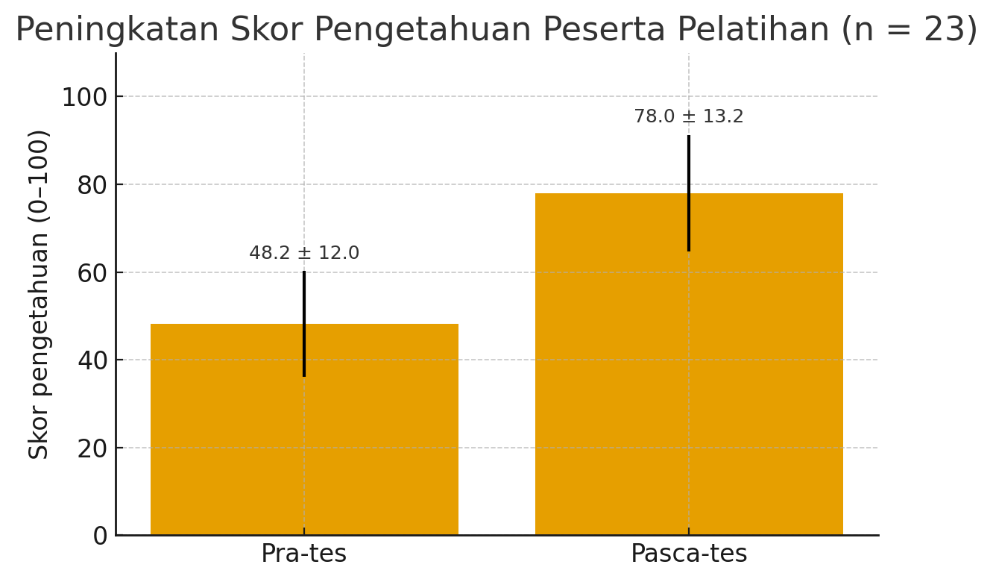
Rural farming in Gedangan Village, Sumobito District, relies on rice as the staple crop and faces rising labor costs, declining farm labor availability, and weather variability that disrupts timely crop establishment. This community service program addressed these constraints by introducing direct seeding of rice supported by a simple manual tool that delivers more uniform seed spacing. The objectives were to strengthen farmer knowledge, demonstrate a low-cost implement that can be fabricated locally, and reduce dependence on scarce labor while maintaining establishment quality. Using a participatory action research approach, the team coordinated with village leaders and farmer groups, conducted a rapid needs assessment, co-designed and built the tool from local materials, delivered classroom briefings, led a field demonstration with guided practice, and facilitated reflective discussion. Evaluation combined pre and post knowledge tests, observation checklists, and participant feedback. Twenty-three farmers completed the activities. Average knowledge scores increased from 48.7 to 79.4 (scale 0–100), and farmers reported faster planting, more uniform spacing, and reduced seed use. The village received a working prototype for continued use, and farmer leaders committed to replicate the tool and plan a direct-seeding schedule for the next season. The program provides a practical, replicable pathway for smallholders to adopt direct seeding that improves efficiency and supports resilience under labor constraints and variable weather.
Downloads
Published
Issue
Section
License
Copyright (c) 2026 Mohamad Nasirudin, Sulthon Ali Musti, Nora Asya Wibawanti, Afifuddin Afifuddin; Fitroh Choirunisa, Alan Hafinudin; Abu Na’im; Siti Aminataz Zuhriyah; Ambar Susanti, Azhar Irfana Gangsar, Choirul Anam

This work is licensed under a Creative Commons Attribution 4.0 International License.